Ansul Fire Extinguishing Agent :: Firefighting Foams
What is Firefighting Foam?
Chemical formulations aside, a firefighting foam is simply a stable mass of small, air-filled bubbles with a lower density than oil, gasoline, or water. The foam is made up of three ingredients...water, a foam concentrate and air. The water is mixed with the concentrate to foam a foam solution. This solution is then mixed with air to produce the foam which is very fluid and flows readily over liquid surfaces.
How do Foam Agents Work?
Firefighting foam agents suppress fire by separating the liquid fuel from the air (oxygen). Depending upon the type of foam agent, this is done in several ways:
- Foam blankets the fuel surface, smothering the fire
- Foam blanket separates the flames from the fuel surface
- Foam cools the fuel and adjacent heat and ignition sources
- Foam blanket suppresses the release of flammable vapors that can mix with air.
Types of ‘Class B’ Foams Types of ‘Class B’ Foams
Aqueous Film-Forming Foam (AFFF)
AFFFs are based on combinations of fluoro-chemical surfactants, hydrocarbon surfactants, and solvents. These agents require a very low energy input to produce a high quality foam. Consequently, they can be applied through a wide variety of foam delivery systems. This versatility makes AFFF an obvious choice for airports, refineries, manufacturing plants, municipal fire departments, and any other operation involving the transportation, processing, or handling of flammable liquids.
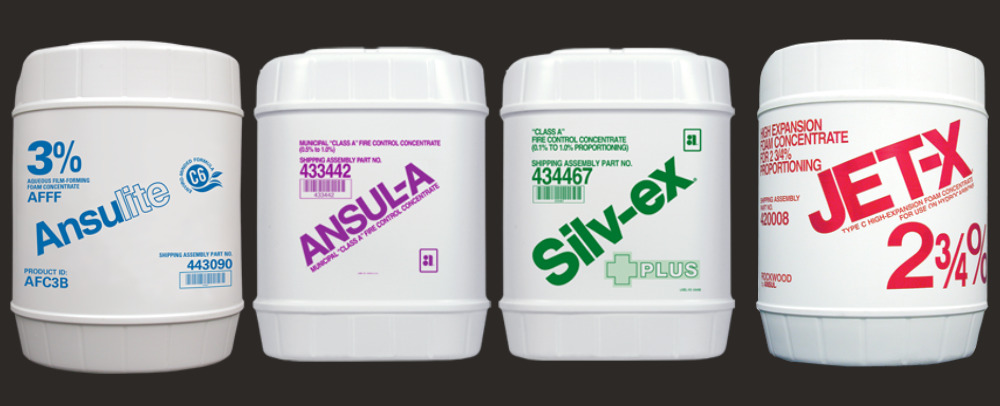
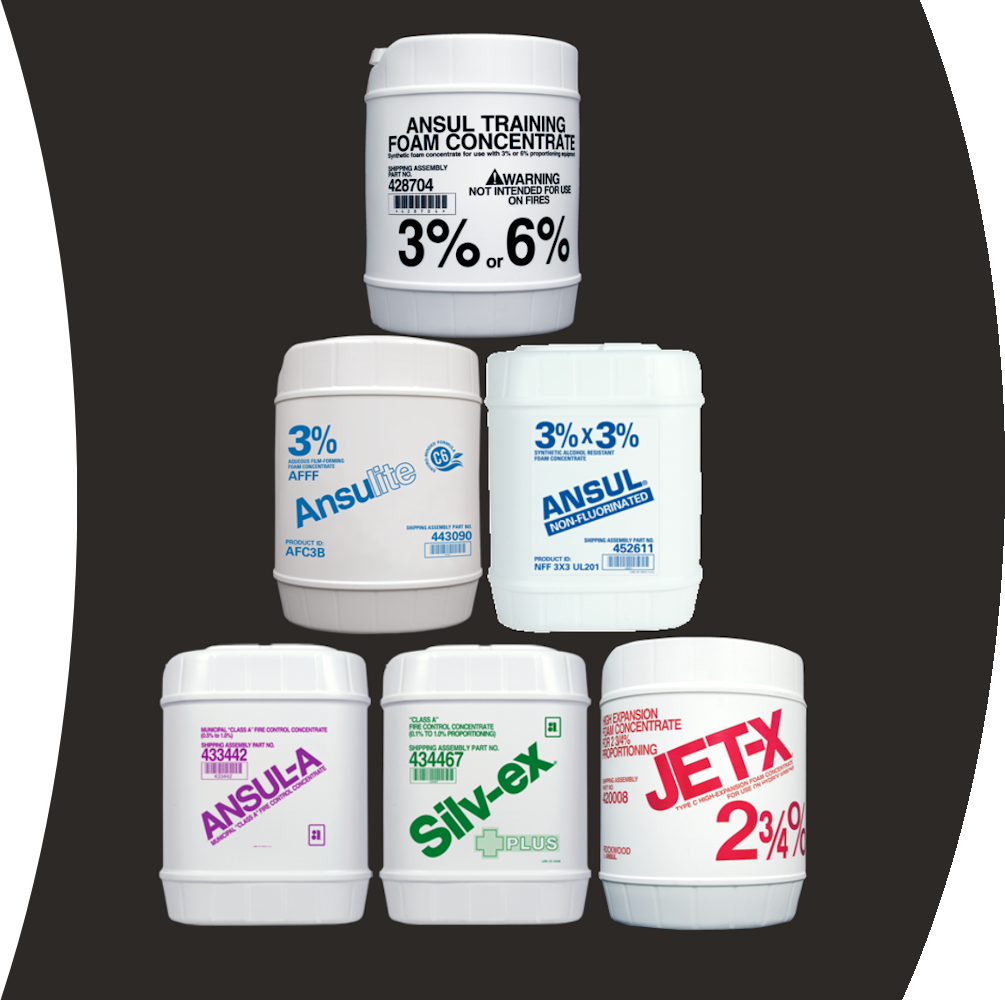
Ansulite® AFFF is available as 1%, 3%, and 6% concentrates or as 1% and 3% freeze-protected concentrates.
Alcohol-Resistant Concentrates (ARC)
Alcohol-resistant foams are based on AFFF chemistry to which a polymer has been added. ARCs are the most versatile of the foam agents in that they are effective on fires involving polar solvents like methanol as well as hydro-carbon fuels like gasoline. When used on a polar solvent type fuel, the ARC concentrate forms a polymeric membrane which prevents destruction of the foam blanket. When used on hydrocarbon fuels, the alcohol-resistant concentrate produces the same rugged aqueous film as a standard AFFF agent. Alcohol-resistant concentrates provide fast flame knockdown and good burnback resistance when used on both types of fuels. Ansulite® 3x3 and 3% / 6% alcohol-resistant AFFF concentrates are available.
Protein Foam Concentrates
Protein foams are recommended for the extinguishment of fires involving hydrocarbons. They are based on hydrolyzed protein, stabilizers, and preservatives. Protein foams produce a stable mechanical foam with good expansion properties and excellent burnback resistance characteristics. Ansul offers protein foam as 3% and 6% concentrates.
Fluoroprotein Foam Concentrates
Fluoroprotein foams are based on hydrolyzed protein, stabilizers, preservatives, and synthetic fluorocarbon surfactants. When compared to protein foams, fluoroproteins provide better control and extinguishment, greater fluidity, and superior resistance to fuel contamination. Fluoroprotein foams are useful for hydrocarbon vapor suppression and have been recognized as very effective fire suppressing agents for sub-surface injection into hydrocarbon fuel storage tanks. Ansul offers fluoro-protein foam in a 3% concentrate.
High Expansion Foam Concentrates
High expansion foams are based on combinations of hydrocarbon surfactants and solvents. They are used with foam generators for applying foam to large areas in total flooding and three-dimensional applications such as warehouses, ship cargo holds, and mine shafts. They are especially useful on fuels such as liquefied natural gas (cryogenic fuels) for vapor dispersion and control. In certain concentrations, high expansion foams are effective on hydrocarbon spill fires of most types and in confined areas. Ansul offers Jet-X® high-expansion foam in a 2.75% concentrate.
|